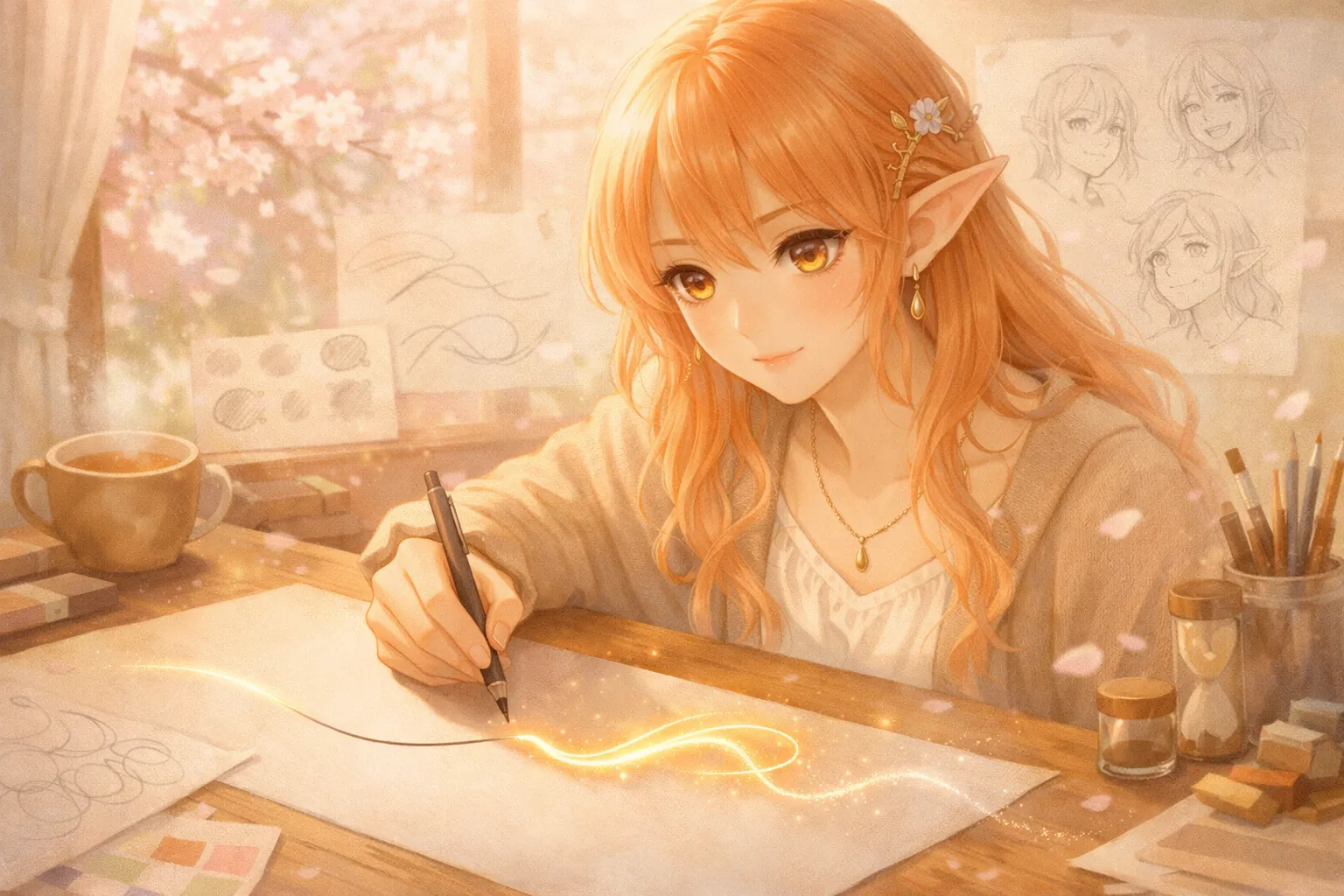
The Line — From Visible Form to the Language of Gesture
The Line as Visual Phenomenon
(What the eye perceives even before understanding)
A line is a trace.
Before it becomes language, it is visible matter.
Before it becomes emotion, it is phenomenon.
To look at a line is to observe energy frozen in time.
Thickness: The Breath of the Line
A line does not always have the same density.
- Thin line → lightness, fragility, luminosity
- Thick line → weight, grounding, stability
- Gradual variation → volume, depth
Thickness creates visual hierarchy.
It naturally guides the eye.
A slightly thicker contour beneath a strand of hair suggests shadow.
A thinner line in the light suggests air.
Variation is essential.
A uniform line becomes monotonous.
2. Pressure: The Intensity of the Gesture
Pressure reads like a pulse.
- Light pressure → grazing touch
- Strong pressure → assertion
- Modulated pressure → organic quality
Pressure reflects the relationship between the hand and the surface.
It reveals the level of engagement.
Constant pressure makes a drawing mechanical.
Modulated pressure makes it alive.
3. Continuity: Fluidity or Fragmentation
A line can be:
- Continuous and fluid
- Segmented and nervous
- Suggested and partially absent
A continuous line conveys confidence and stability.
A fragmented line may convey tension or hesitation.
Continuity deeply influences the overall sensation of a drawing.
4. Speed: Energy Inscribed
The speed of the gesture is visible.
- Fast line → spontaneity
- Slow line → control
- Alternation → natural rhythm
A line that is too slow may become rigid.
A line that is too fast may become imprecise.
Balance creates vitality.
5. Rhythm: Alternation and Breath
A living drawing alternates:
- Long lines / short lines
- Curves / angles
- Dense areas / airy areas
Rhythm prevents monotony and allows the eye to move freely.
6. Texture: The Skin of the Line
The surface and tool influence texture:
- Pencil → grain
- Ink → sharpness
- Charcoal → diffusion
- Digital → adjustable
Texture adds a subtle tactile dimension.
7. Solid and Void: Dialogue with Space
A line never exists alone.
It dialogues with space.
A contour may be interrupted.
Empty space may suggest more than a complete line.
Void strengthens the line.
The line structures the void.
Synthesis
A visually living line combines:
- Variation in thickness
- Modulation of pressure
- Controlled continuity
- Perceptible speed
- Balanced rhythm
- Subtle texture
- Dialogue with space
It is an invisible architecture.
Energy captured in matter.