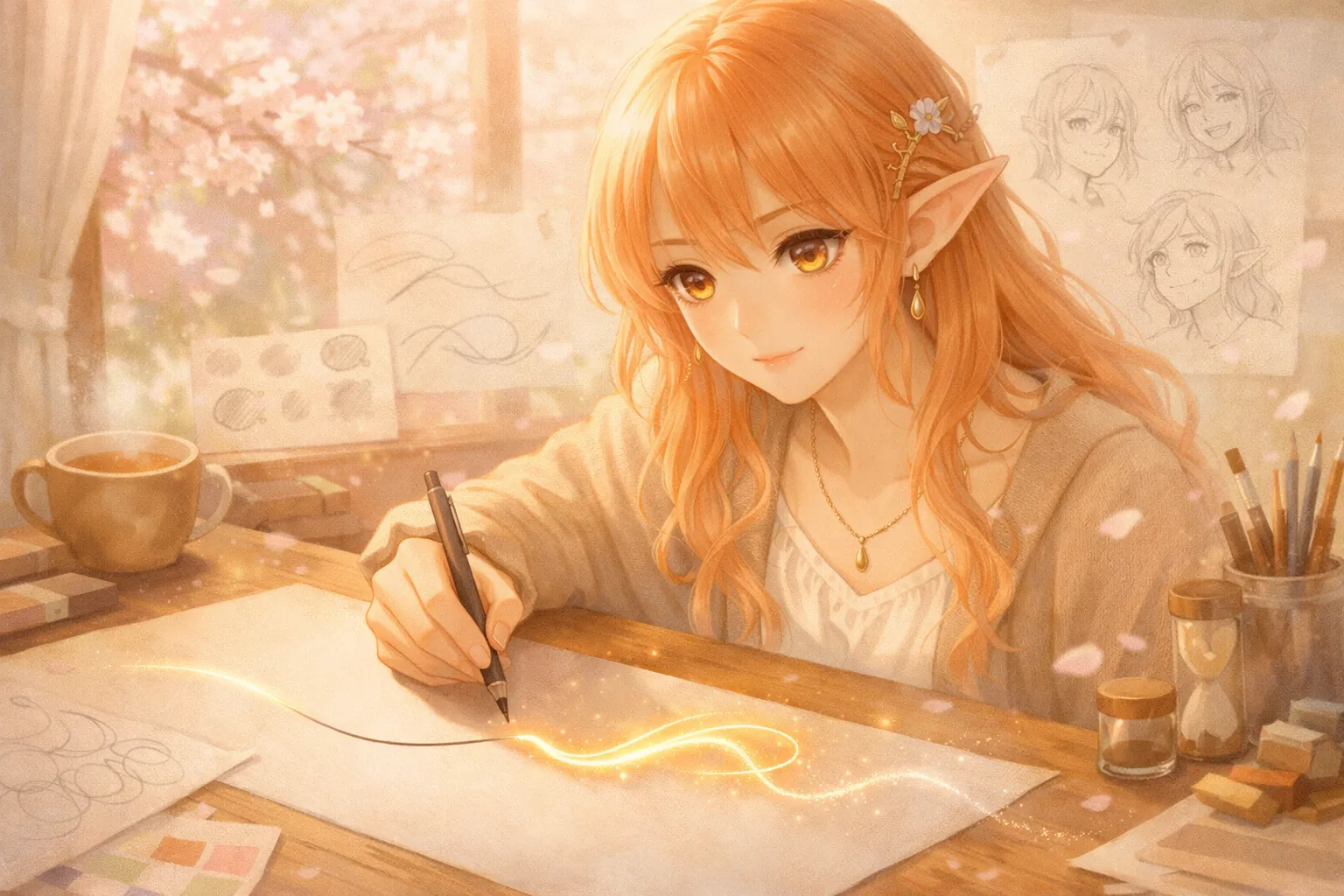
The Line — From Visible Form to the Language of Gesture
The Line as Language
(What the line means beyond what it shows)
If the line is first a visual phenomenon,
it then becomes language.
A simple variation in line can transform the perception of a face, a body, a landscape.
The line does not merely describe: it interprets.
1. Line and Emotion
The quality of a line directly influences the feeling it conveys.
- Trembling line → fragility, doubt, vulnerability
- Angular line → tension, hardness, conflict
- Rounded and fluid line → softness, calm
- Broad and open line → freedom, breath
The viewer does not consciously read these codes,
but feels them instinctively.
The same face drawn with different lines does not tell the same story.
2. Line and Character
The line can reveal the personality of a subject.
- Clear and assertive contours → stable character, strong presence
- Thin and delicate lines → sensitivity, subtlety
- Irregular and vibrating lines → inner energy
- Extreme simplification → minimalism, restraint
The choice of line becomes a narrative decision.
3. Line and Visual Hierarchy
Not everything should have the same intensity.
Thickening certain contours, lightening others,
emphasizing specific areas — this guides the eye.
The line creates hierarchy:
- What is important is affirmed
- What is secondary is suggested
- What is silent may disappear
The hierarchy of the line organizes the reading of the image.
4. Line and Narrative
The line participates in storytelling.
A dynamic line of action suggests movement.
A closed and stable contour suggests stillness.
The drawing becomes a frozen sequence of a broader motion.
The line indicates:
- Direction
- Weight
- Tension
- Intention
It does not only show a shape,
it shows what is happening.
5. The Silence of the Line
Sometimes, not drawing is more powerful than drawing.
Leaving a contour open
or suggesting a form through negative space
creates lightness and depth.
Visual silence is a component of graphic language.
6. Consistency and Style
A style is born from the conscious repetition of choices.
- Dominant thickness
- Type of curves
- Handling of angles
- Level of simplification
What appears instinctive is often the result of maintained coherence.
The line then becomes a signature.
Synthesis
The line as language combines:
- Emotional expression
- Revelation of character
- Visual hierarchy
- Narrative direction
- Use of silence
- Stylistic coherence
It is no longer just about drawing,
but about deciding what the line must say.
A drawing begins as a visual phenomenon.
It becomes an artwork when the line speaks.