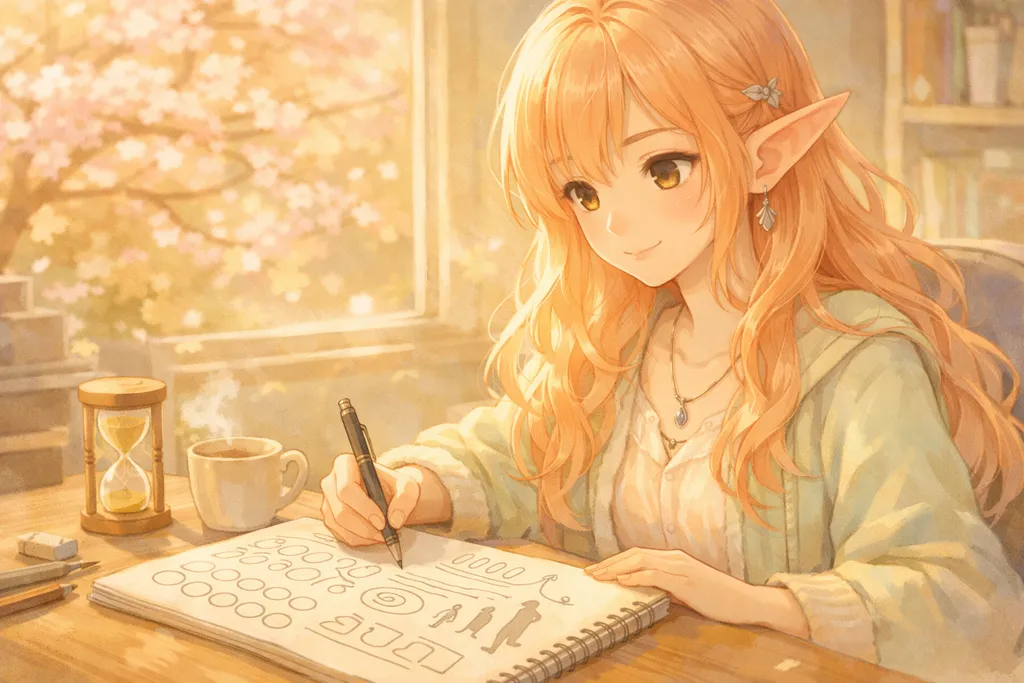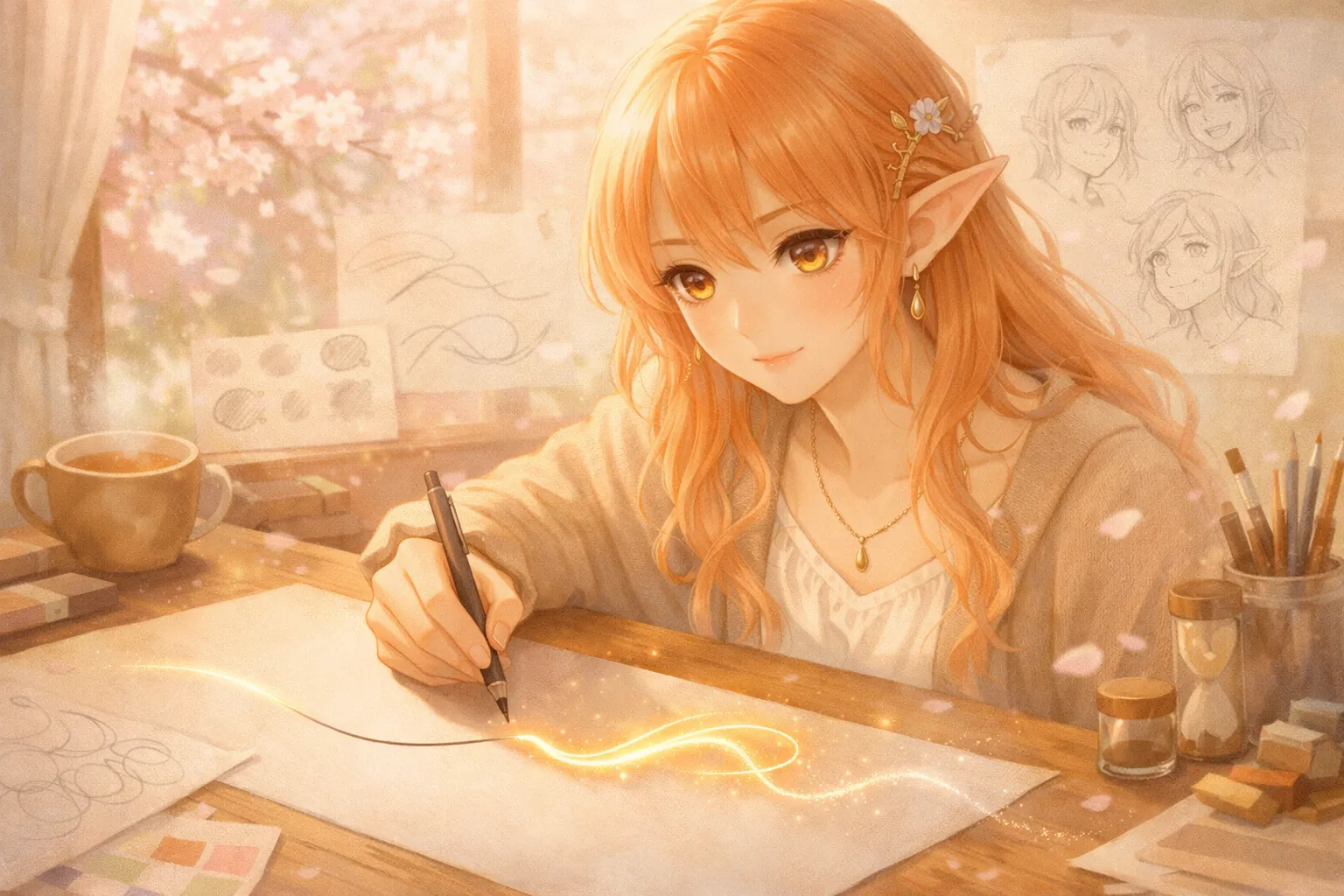
The Line — From Visible Form to the Language of Gesture
Progressive Exercises
(Putting the line into practice)
Understanding the line is not enough.
It must be practiced, experienced, and observed as it evolves.
This chapter proposes a structured progression.
Each exercise develops a specific aspect: control, variation, energy, decision.
1. Daily Warm-Up: Freeing the Gesture
Recommended duration: 5 to 10 minutes.
Objective: loosen the arm and activate fluidity.
Exercises:
- Draw long straight lines in a single motion.
- Sketch wide arcs using the shoulder.
- Create continuous spirals without lifting the tool.
- Draw circles in one stroke, without correction.
Essential rule:
One pass per line. No going over it again.
Goal: prioritize fluidity over perfection.
2. Pressure Control: Modulating Intensity
Recommended duration: 5 minutes.
Objective: consciously vary line thickness.
Exercises:
- Series of very thin lines.
- Series of thick lines.
- Lines transitioning gradually from thin → thick → thin.
- Repeat with curves and S-shaped forms.
Observe:
- The smoothness of the transition.
- The stability of the hand.
- The absence of involuntary trembling.
3. Variation and Rhythm: Avoiding Monotony
Recommended duration: 5 to 10 minutes.
Objective: introduce visual rhythm.
Exercises:
- Draw an imaginary plant using only lines.
- Practice strands of hair with long/short alternation.
- Study fabric folds by varying thickness and density.
- Alternate detailed areas and simplified areas.
Look for:
- Contrast between tension and release.
- Alternation between dynamic and calm lines.
4. Line of Action: Capturing Energy
Recommended duration: 10 minutes.
Objective: work on movement before detail.
Exercises:
- Draw 10 silhouettes in 30 seconds each.
- Begin with a single dominant line of action.
- Add minimal structure without stiffening the pose.
Do not correct.
Prioritize the initial impulse.
Goal: feel the movement before describing it.
5. Voluntary Simplification: Decision and Clarity
Recommended duration: 5 to 10 minutes.
Objective: strengthen decision-making ability.
Exercises:
- Draw a simple object using a maximum of 15 lines.
- Forbid any retracing.
- Intentionally omit certain contours.
- Summarize a complex shape with a few essential lines.
Goal: learn to decide what is necessary.
6. Advanced Exercise: One Single Line
Objective: coordination and continuity.
Exercise:
- Draw a face or silhouette without lifting the tool.
- Maintain a continuous flow.
- Accept imperfections.
This exercise develops fluidity and overall coherence.
7. Analytical Observation
Objective: learn to see.
Choose a drawing (your own or another artist’s).
Analyze:
- Where is the line thicker?
- Where does it become thinner?
- Are there intentional breaks?
- How does the eye move?
Visual understanding improves practice.
Suggested Weekly Routine
- Day 1: Warm-up + pressure
- Day 2: Rhythm + simplification
- Day 3: Line of action
- Day 4: One-line exercise
- Day 5: Study an existing drawing
- Day 6: Free application
- Day 7: Critical review and adjustments
Synthesis
Progress relies on:
- Regularity
- Awareness of gesture
- Careful observation
- Acceptance of imperfection
- Assumed decision-making
A line improves through conscious repetition.
Mastery does not come from a perfect drawing.
It comes from thousands of lines drawn with intention.